

Love is already being sent: the photo from the walk to school, the voice note from the airport, the joke that only makes sense to your family. Too often, it arrives as one more notification.
Our founding team knows the pattern because many of us live a long flight and several time zones from home. We send pictures. Our parents react with a heart. Then both sides return to their day. The content arrived, but the feeling did not always have somewhere to go.
The short answer
We are building HeyBondi because families do not need another place to store photos or another app asking parents to check a feed. They need ordinary updates to become easy moments of presence. Bondi is being designed as a voice-first photo frame for a parent’s home: it can show a family photo, tell the story that came with it, invite a natural response, and return that story to the family—with no camera and no surveillance.
Key takeaways
- The problem is not a shortage of photos. It is that family updates often become passive, private, or easy to miss.
- Bondi is designed for a parent’s home rather than another phone workflow.
- Voice, familiar objects, and ordinary moments shape the product more than a long list of app features.
- No camera is a deliberate boundary: companionship should not require surveillance.
- HeyBondi is still being built. We will distinguish current design intent from finished, guaranteed outcomes.
The love is already being sent
Most long-distance families are not starting from silence. They are texting, calling, sharing photos, and sending quick updates whenever life leaves a gap.
In a 2024 Pew Research Center survey of U.S. adults ages 18 to 34, 61% said they texted the non-co-resident parent they contacted most at least a few times a week; 23% did so daily. Two-thirds said they communicated with a parent as often as they wanted, while 27% wanted more contact. The gap is not simply whether contact happens. It is whether that contact feels like enough.
A family can exchange twenty messages and still miss each other’s everyday life. The group chat carries flight times, birthday reminders, and its own strange communication rules. The weekly call carries the headlines. What disappears in between are the tiny details: why the child is wearing two different socks, what made Dad laugh at breakfast, or why the dog is suddenly afraid of the new garden statue.
Those details are not filler. They are the texture that lets someone feel included in a life they cannot physically enter every day.
The family connection problem is not always “We never talk.” Sometimes it is “We share a lot, but very little becomes a moment together.”
Why we are building around ordinary moments
Big occasions create memories, but repeated small moments create continuity. Birthdays and holidays matter. So do the Sunday grocery report, the school-run photo, and the same joke told for the fifteenth time.
A classic review of 50 years of research on family routines and rituals, summarized by the American Psychological Association, distinguished routines that organize what a family does from rituals that communicate who a family is. Across the 32 studies reviewed, everyday activities such as meals, chores, phone calls, and visits could take on shared meaning. The review was published in 2002 and cannot tell us whether a new device improves a relationship. It does support the narrower design insight that repetition and symbolic meaning are important parts of family life.
That changed the question we wanted to solve. Instead of asking, “How can we display more photos?” we asked, “How can one ordinary photo open a small, repeatable family moment?” Families can try opening that moment with one photo, and use low-pressure family connection instead of waiting for the perfect long call.
Our research-led look at why ordinary family photos gain meaning over time explains how rediscovery, memory cues, and family context can change the value of a seemingly routine image.
| What gets sent | What often happens now | What Bondi is designed to invite |
|---|---|---|
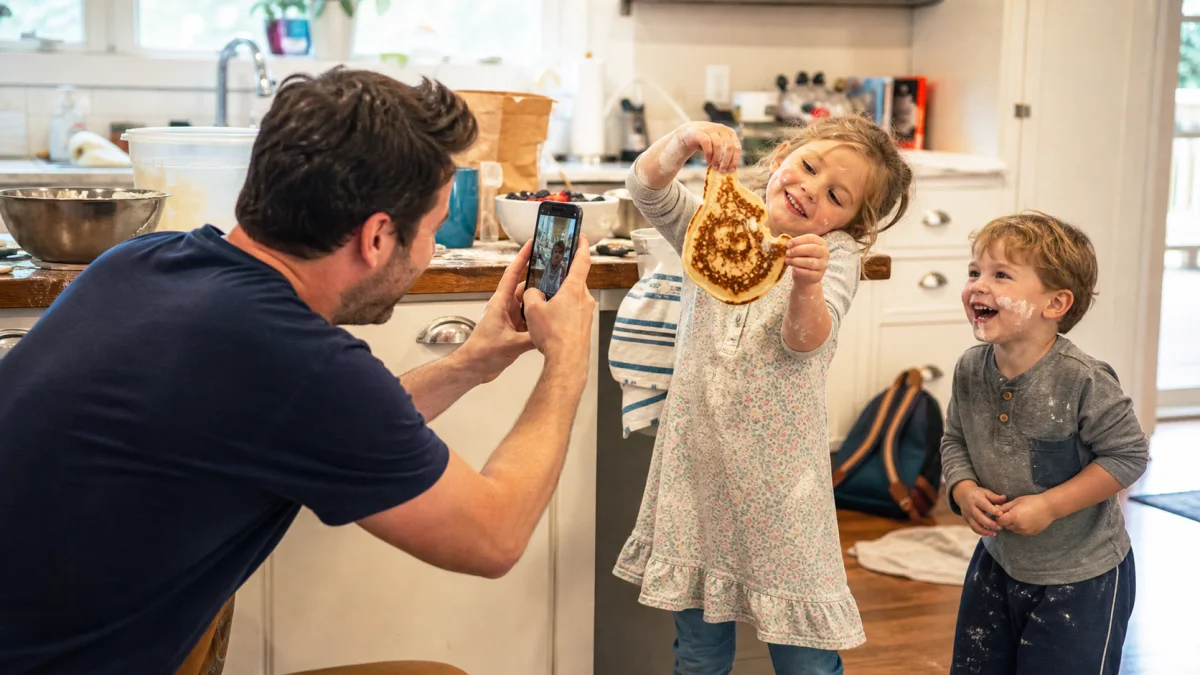
| A messy baking photo | A heart reaction, then the feed moves on | The story behind the mess, followed by a parent’s own memory |
| A child’s first goal | The photo is saved but rarely discussed | A spoken celebration that becomes part of the family story |
| A garden update | One person sees it between other alerts | A calm moment at home that can begin a conversation |
| A short voice greeting | It waits in a busy messaging app | A familiar voice arriving in the room without a menu to navigate |
These are product design intentions, not claims that a device can guarantee closeness or replace direct family contact.
Why we did not want to solve this with another app
An app can be easy for the sender and still be the wrong destination for the receiver. Every additional login, menu, notification, and update asks a parent to adapt to the product before the product has earned a place in daily life.
That does not mean older adults reject technology. AARP’s 2026 Tech Trends and Adults 50-Plus surveyed 3,838 U.S. adults in late 2025 and found 90% smartphone ownership among adults 50 and older. Texting was their leading communication method. The same survey also found that three in five felt technology was not designed with their age in mind, while privacy, setup and support, cost, and relative value remained barriers.
We read that tension as a design challenge, not a stereotype. Parents are already capable technology users. They should not have to prove that capability every time they want to see a photo from their family.
So Bondi is designed to live in the home as a familiar photo frame. The family handles setup and sharing. The parent should be able to look, listen, and speak without hunting through a phone. The interface begins with an action people already know: conversation.
Five principles shaping Bondi
These principles are the filter for product decisions. A feature that sounds impressive but makes the experience busier, less private, or less human has failed the filter.
Start with a frame, not a dashboard. Bondi should look at home on a side table and make its purpose understandable before anyone reads a manual.
Let conversation be the interface. Parents should not need to learn nested menus, remember passwords, or perform a sequence of taps for a simple family moment.
A photo should carry context. Bondi is designed to show the image, share the family’s story, and make room for the parent’s response rather than acting as a silent slideshow.
No camera and no surveillance. Smart sensing is intended to help the frame respond to presence and light, not to turn a parent’s home into a monitoring feed.
Do not manufacture urgency. Photos, greetings, stories, and gentle reminders should fit the rhythm of the home instead of competing with every phone alert.
These choices also explain why Bondi is not only a digital photo frame. A passive frame can display a picture beautifully, but it stops at the image. We want the image to become the beginning of a story, a laugh, or a small piece of family knowledge that comes back.
What the current HeyBondi design is meant to do
Bondi combines family photos and voice with a small set of everyday companion behaviors. The current product page describes a 10.1-inch matte display, dual speakers, far-field microphone, mmWave radar, ambient-light sensing, Wi-Fi 6, Bluetooth 5.3, local encrypted data storage, and no camera.
Those specifications matter only when they serve a human moment. Today, the product is being designed around these jobs:
- Show a family photo and speak the story sent with it
- Invite a parent to respond naturally and save that response as a family story
- Offer daily check-ins and gentle reminders without turning care into surveillance
- Play familiar content such as music, reading, or a morning update
- Use presence and ambient light to choose a calmer time to appear
The important word is designed. HeyBondi is a pre-order product still in development. The final experience must earn these claims through testing, reliability, accessibility, and real use in parents’ homes.
Why “no camera” is a product decision, not a footnote
A parent should not have to trade privacy for connection. Cameras can be useful in the right product and with informed consent. They are not necessary for the family moments Bondi is designed to support.
Our deeper explanation of why Bondi has no camera separates this visual boundary from the microphone, radar, data processing, access, retention, and control questions that still require transparent answers.
That is why the current hardware specification uses mmWave radar and ambient-light sensing, not a camera. The goal is limited: help the display respond to whether someone is nearby or resting and to the light in the room. Conversation data is described as processed and stored locally and encrypted. Those commitments need to remain visible, testable, and understandable as the product develops.
Privacy is also emotional. If a device feels like it is watching, a warm family gesture can start to feel like supervision. We want adult children to feel closer to home without making parents feel managed inside it.
Why offer a pre-order while Bondi is still being built?
A pre-order is useful only if the uncertainty is stated plainly. It should not disguise development as finished inventory.
The current Founder’s Bundle is limited to 500 numbered units. A reservation costs $9.90 and is described as fully refundable any time before shipping. The listed device price is $299 when Bondi ships, with U.S. shipping included, six months of membership, priority shipping, and a direct line to the team. The current estimated ship date is December 2026. If timing changes, the product page says families will be updated and the reservation fee remains refundable.
Those are today’s published terms, not a promise that development contains no risk. The point of a founder program is to make that stage visible and to build with people who care about the problem enough to give precise feedback—not to pretend the product is already complete.
Frequently asked questions
Is HeyBondi just a digital photo frame?
No. It includes a photo-frame experience, but the current design uses family photos as the beginning of spoken stories, responses, check-ins, and everyday conversation rather than stopping at a silent slideshow.
Does Bondi have a camera?
No. The current hardware specification lists mmWave radar and an ambient-light sensor for smart sensing, with no camera. HeyBondi describes conversations and personal data as processed and stored locally and encrypted.
Do parents need to learn another app?
The family uses the setup and sharing tools, while the parent-facing experience is designed around a familiar frame and voice. The product goal is to reduce menus, passwords, and repeated phone tasks for parents.
Can HeyBondi replace family calls or visits?
No. Bondi is meant to add small moments between calls and visits, not replace direct relationships. A device cannot guarantee closeness or stand in for the people who care.
Is the $9.90 reservation refundable?
The current pre-order terms state that the $9.90 reservation fee is fully refundable at any time before shipping. Review the live product page and terms for the latest pricing, timing, and cancellation information before reserving.
What success would look like
Success is not a parent staring at a screen for longer. It is a picture from an ordinary day landing at the right moment, carrying enough story to make someone smile, and bringing back a memory the rest of the family had never heard.
It is an adult child learning what happened in the kitchen after the photo was taken. It is a parent feeling part of the week, not only invited to the holiday, something families can also build with a simple everyday-sharing rhythm for parents. It is a family having more ways to be present without turning affection into another obligation.
That is the standard we are building toward: not more content, but more moments that feel shared.