

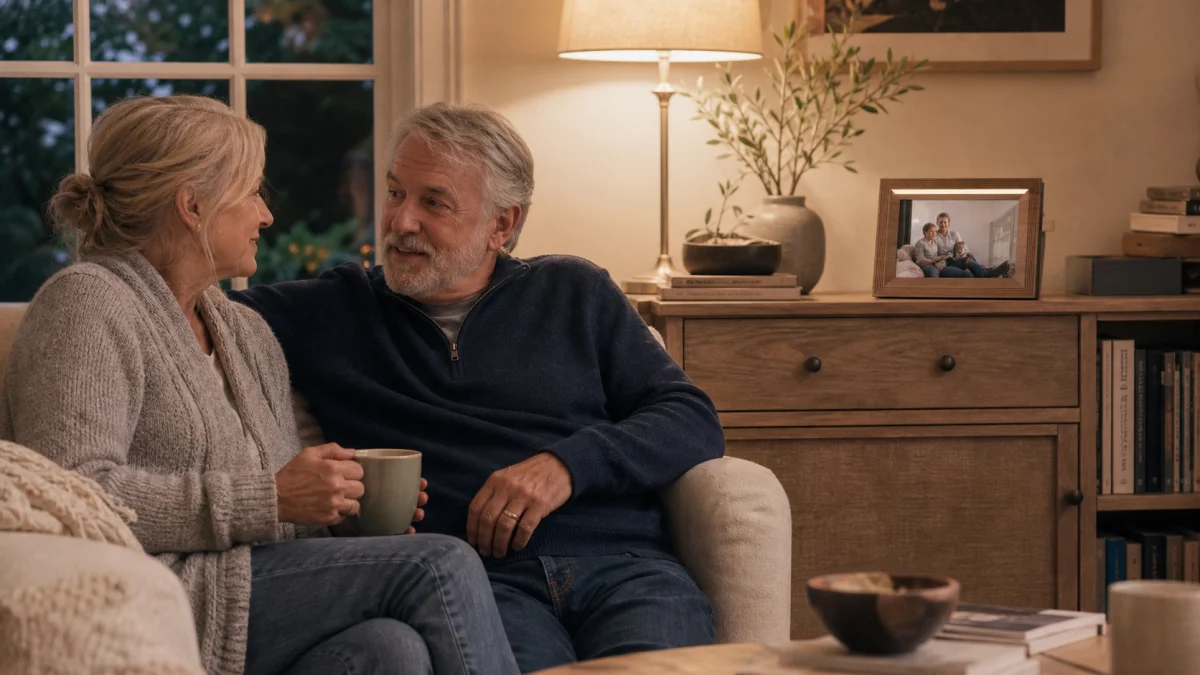
A camera can answer a worried adult child’s question in seconds. It can also change what it feels like to make coffee, welcome a friend, or cross the living room in pajamas. Bondi begins from a different premise: family connection should not require a visual window into a parent’s home.
The short answer
Bondi’s current published hardware specification lists no camera. That removes photographs, video, facial imagery, and a live visual feed from the experience HeyBondi is designing. Research with older adults suggests that distinction matters because cameras can become a flashpoint around privacy, autonomy, and trust inside the home.
No camera does not mean no sensing. Bondi’s current specification also lists a far-field microphone, mmWave radar, and an ambient-light sensor. Its privacy case therefore depends on more than the absence of a lens. What is collected, why it is needed, where it is processed, who can access it, how long it remains, and what control the parent has all matter.
Key takeaways
- No camera is a meaningful boundary because Bondi is not designed to create photographs, video, or a visual feed from a parent’s home.
- Older adults may welcome useful technology while still caring deeply about who can access information about their daily lives.
- Nonvisual sensors collect less visually revealing information, but they can still reveal presence, movement, routines, or conversation.
- Privacy is a whole-product responsibility involving purpose, collection, processing, access, retention, and control.
- HeyBondi is still in development. Its current specifications and privacy statements are first-party commitments, not independently tested outcomes.
Why a camera changes the feeling of home
A camera does more than detect that someone is present. It opens a recognizable view into the room. Clothing, visitors, facial expressions, possessions, and the ordinary disorder of daily life can all become visible. Even when nobody is actively watching, knowing that someone could watch may change how private the room feels.
A 2019 study by Clara Berridge and Terrie Fox Wetle conducted 28 in-depth interviews with 18 older women receiving Meals on Wheels and 10 of their adult children. Cameras caused the most disagreement among the three monitoring technologies discussed. The mothers connected privacy with independence, freedom, identity, and the ability to live without feeling watched. Their adult children generally favored the technologies more strongly.
The study was small, all of the older participants were women, and many had chronic health or financial challenges. It cannot tell us what every family will choose. It does show why privacy cannot be reduced to whether someone has “something to hide.” In a parent’s home, privacy can mean having room to remain fully oneself.
A second 2013 longitudinal U.S. study led by Linda Boise followed 119 older research volunteers using unobtrusive motion and computer monitoring. The participants were 83 years old on average, 78% were women, and they were more highly educated and technologically experienced than the wider older population. More than 72% accepted useful monitoring and sharing with family or doctors, yet 60% also reported privacy or security concerns. Among cognitively intact participants, willingness to be videotaped around the home fell from 20% at baseline to 7% one year later.
A person can see value in technology and still want firm boundaries around what it reveals.
The same device can look different from each side of the family
Adult children often buy the technology, but parents live with it. The child may see reassurance. The parent may see a new observer in a space that has always been their own. Neither reaction has to come from bad intent.
Older adults are not a technology-averse group waiting to be persuaded. AARP’s 2026 Tech Trends and Adults 50-Plus drew on an online survey of 3,838 U.S. adults conducted from September 9 to October 6, 2025. It reported 90% smartphone ownership among adults 50-plus, while data privacy remained the leading overall barrier to adopting more technology. Three in five said technology was not designed with their age in mind. The survey is self-reported and the published total includes adults under 50, so it should describe broad attitudes rather than predict one parent’s decision.
The better starting question is not “How do I convince Mom or Dad?” It is “What would make this feel useful and respectful to them?” That same principle runs through practical ways to help parents feel part of everyday family life: give them a role, offer a choice, and make room for a real answer.
A 2023 ACM study by Jiachen Li and colleagues explored this tension through two focus groups, separate interviews with five older adults and five adult children, activity ratings, and prototype testing. Raw video was easiest for children to interpret, but location-based visualizations provided a better balance between awareness and older adults’ comfort. The sample was small, and the older adults in the final user test had mild cognitive impairment, so the findings are design guidance rather than a universal rule. The useful point is narrower: maximum detail is not always the right design goal.
What “no camera” removes, and what it does not
In Bondi’s current design, no camera means no ordinary photographic or video view of the home. That is a first-party hardware statement from HeyBondi, not the result of an independent teardown or privacy audit. It should be presented as a current product commitment while Bondi remains in development.
No camera also does not mean no data. A microphone can receive speech. Radar can register reflections associated with presence and movement. Even a modest sensor can reveal a routine when readings accumulate over time. The honest privacy question is not simply whether a lens is present. It is what the complete system can learn and what happens next.
What Bondi’s current sensors are designed to do
Bondi’s published specification uses different components for different, limited jobs. The table separates HeyBondi’s current first-party description from what the broader sensor category can reveal.
| Component | Current HeyBondi description | Privacy meaning |
|---|---|---|
| No camera | No visual capture or camera feed is part of the published design. | Removes ordinary photographs, video, facial imagery, and recognizable room views. |
| mmWave radar | Listed in the current hardware specification. HeyBondi separately says “smart sensing” helps Bondi light up when someone is nearby or resting. | Can sense radio reflections associated with presence and movement. More advanced systems can infer activities or bodily patterns. |
| Ambient-light sensor | Listed in the current hardware specification; the published pages do not yet document its complete data flow. | Measures environmental brightness rather than creating an image. |
| Far-field microphone | Supports Bondi’s voice-first conversation experience. | Speech is sensitive information, so activation, processing, retention, and access require clear explanation. |
| Local encrypted storage | HeyBondi currently says conversations are processed locally and data is stored locally and encrypted. | This is a first-party architecture commitment. The inspected product pages do not provide an independent audit, retention schedule, or complete technical threat model. |
The final product must be checked against these published specifications. Sensor capability in outside research does not establish what Bondi currently collects or infers.
A 2025 review of mmWave medical sensing by Xiaoyu Zhang and colleagues screened 17,900 search results, narrowed them to 523 relevant papers, and selected 66 end-to-end systems for detailed analysis. Across those systems, radar signals could be mapped to movement, respiration, heart rate, gait, and other biomarkers. Most applications remained laboratory or proof-of-concept work, and the review did not study Bondi. Its relevance here is cautionary: radar is less visually revealing than a camera, but it should not be described as incapable of producing personal information.
Privacy is a whole-product design decision
A private-feeling product needs more than a camera-free parts list. NIST’s 2022 consumer IoT cybersecurity baseline was developed after a review of existing guidance and a year of stakeholder engagement. It emphasizes product-level data protection, restricted interfaces, secure updates, device-state awareness, and documentation. It is a voluntary baseline, not a certification of Bondi or any other product.
The Federal Trade Commission reached a complementary conclusion in its 2015 Internet of Things staff report. Drawing on a public workshop, expert participation, industry input, consumer advocates, and comments, the FTC recommended security by design, data minimization, limited retention, notice, and meaningful choice. The report is older and nonbinding, but its central question remains useful: does the product collect only what it needs for the service the family expects?
Name the job before collecting the data. A sensor should have a specific, understandable reason to exist.
Gather the minimum needed. More detail is not automatically more useful, especially inside a home.
Explain what happens on the device and what leaves it. “Local” should describe a testable data flow, not simply a reassuring word.
Limit who can see information and how long it remains. Raw data, summaries, backups, and service logs may need different rules.
Keep the parent informed and in control. People should understand when sensing is active and how to pause, delete, or change sharing.
Clear explanations are part of the product, too. In a 2022 Singapore mixed-methods study, smart-home sensors were installed for four to five weeks in 42 older adults’ homes, with in-depth interviews involving 18 older participants and four other stakeholders. Some participants initially worried that the camera-free sensors captured images or speech. Understanding improved when people saw how the system represented their data. The study took place in a trusted community program and offered a free two-year subscription, so its adoption rate should not be generalized to U.S. buyers. Its practical lesson is still sound: “no camera” should be demonstrated and explained, not left as fine print.
Questions to ask before bringing any smart device into a parent’s home
Start with the information flow, then decide together whether the benefit is worth it. These questions apply to Bondi, cameras, speakers, safety sensors, and other connected devices:
- Does it capture images, audio, location, movement, or inferred activity?
- Which features need each type of information?
- What is processed on the device, and what is transmitted elsewhere?
- Who can access raw data, family content, summaries, or service logs?
- How long is information retained, and how can it be deleted?
- Can the person living with the device pause sensing or revoke access?
- How will visitors know what the device can sense?
- How long will security updates and support continue?
- What stops working if the internet connection or company service ends?
If the goal is conversation rather than supervision, begin there. A specific memory prompt or ordinary family update may do more than another status dashboard. These questions to ask beyond “How are you?” offer a simple place to start.
The boundary HeyBondi is committing to today
HeyBondi is choosing not to build a visual feed into the family relationship. The current design combines a 10.1-inch display, speakers, a far-field microphone, mmWave radar, ambient-light sensing, and local encrypted storage, with no camera. HeyBondi also says device conversations are processed locally and are not stored in the cloud.
Those are current first-party commitments. They are not independent findings, and Bondi is a pre-order product still in development. The final experience must earn them through testing, clear documentation, reliable controls, accessible setup, and honest updates when the design changes.
Where a camera may still be the right choice
No camera is not a universal rule for every home or every need. A family may choose a camera for a clearly defined safety purpose when the person living there understands it, agrees to it, and controls its placement and access. Needs can also change with health, cognition, living arrangements, and the people providing care.
Bondi is not a medical device, fall detector, emergency service, or proof that a parent is safe. It should not replace a medical alert system, professional care, or direct family contact. Its no-camera design answers a narrower question: how can a family companion invite photos, stories, and conversation without creating a visual feed from the home?
Frequently asked questions
Does Bondi have a camera?
No. HeyBondi’s current published hardware specification lists mmWave radar and an ambient-light sensor, with no camera. Bondi is still in development, so the final product should be checked against the live specifications before purchase.
Does no camera mean Bondi collects no data?
No. The current specification includes a far-field microphone, mmWave radar, and ambient-light sensing. HeyBondi says conversations are processed locally and data is stored locally and encrypted, but those are first-party product commitments rather than independent audit findings.
What does mmWave radar detect?
mmWave radar measures radio reflections that can indicate presence, position, and movement. Advanced research systems can infer more detailed activities or bodily patterns, but that does not establish what Bondi’s current implementation collects or infers.
Are cameras always inappropriate in a parent’s home?
No. A camera may be appropriate for a defined need when the person living there gives informed consent and controls placement and access. The decision should account for privacy, autonomy, visitors, recording, security, and whether a less revealing option can do the job.
Can Bondi replace a medical alert or home-monitoring system?
No. Bondi is not a medical device, fall detector, emergency service, or proof that someone is safe. It is being designed as a family companion for photos, voice, stories, reminders, and everyday conversation.
The home should still feel like home
A parent should be able to receive a family photo without also opening a window for someone to watch the room. That is why no camera matters. It sets a clear limit on the kind of access Bondi is being designed to provide.
The rest of the privacy work is less visible and just as important. Purpose, collection, local processing, access, retention, security, and control must remain understandable as the product develops. That is part of why we are building Bondi around everyday family moments, not continuous observation. Families can also create that sense of presence now through low-pressure ways to stay close, with or without a new device.