

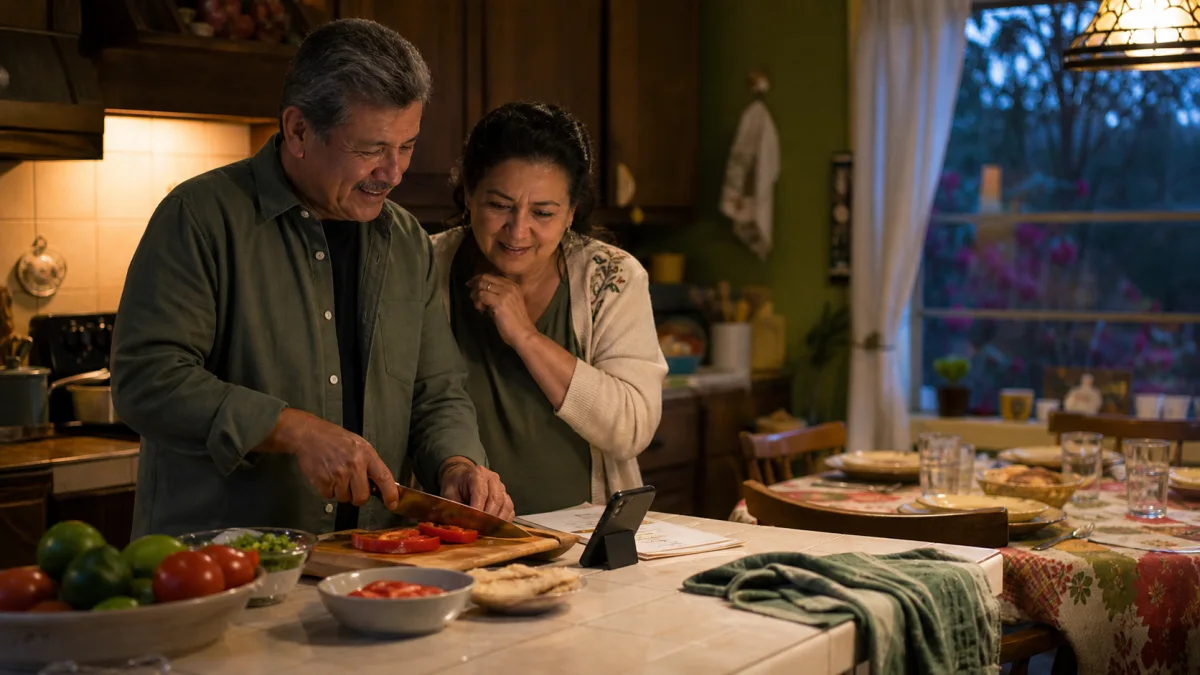
Your parents do not need a polished family highlight reel. They need enough of the ordinary story to know what happened on Tuesday and a genuine way to take part.
That might be a photo of the crooked pancake, a ten-second voice note from the walk home, or a question about which tomato plant to buy. Small updates help parents follow family life between longer calls and visits. The goal is not constant contact. It is to make the week easier to enter. These low-pressure ways to feel closer to family can help if your current routine already feels crowded.
The short answer
Help your parents feel part of everyday family life by sharing small, current moments and giving them a real way to contribute. Use one channel they already like, add context to photos, send voice when tone matters, ask specific questions, and close the loop after they respond. A light weekly rhythm works better than a burst of updates followed by silence. Make every reply optional.
Key takeaways
- Everyday inclusion comes from context and participation, not message volume.
- Use the communication channel your parents already handle comfortably.
- Share unfinished moments, not only birthdays, trips, and final results.
- Invite advice, memories, opinions, humor, or practical help, then show what happened next.
- Create a repeatable rhythm, but never make a parent or adult child owe a daily reply.
Give your parents a role, not just more updates
Feeling included is different from receiving more content. A stream of polished photos may show your parents what the family did without giving them a place inside the story. A less polished message can do more: “We tried your soup recipe tonight. Would you add more ginger next time?”
A useful everyday update has three parts: a current moment, one line of context, and an opening. The opening might be a choice, a request for expertise, an invitation to share a memory, or permission simply to enjoy the update. The fourth step is easy to miss: return later with the outcome. “Your blue paint vote won” shows that the invitation was real.
| Everyday moment | Add context | Offer a real role | Close the loop |
|---|---|---|---|
| Dinner photo | “We tried your soup recipe.” | “More ginger next time?” | Send the revised version later. |
| Home project | “We are choosing a shelf color.” | “Green or blue?” | Show the finished shelf. |
| Busy workday | “This was the view from lunch.” | “What did you pack at my age?” | Share what you remembered. |
| Weekend plan | “We have one free morning.” | “Market or long walk?” | Send one moment from the choice. |
The most useful prompt is specific enough to answer and relaxed enough to leave for later.
Choose a channel around your parents' habits
Start with what your parents already use and enjoy. Do not assume that age predicts digital ability. AARP's 2026 Tech Trends and Adults 50-Plus reports that texting is the leading communication method among U.S. adults 50 and older and that smartphone ownership reached 90% in 2025. The findings came from an online survey of 3,838 U.S. adults conducted in English and Spanish from September 9 to October 6, 2025.
Those group-level findings do not tell you what your own mother or father prefers. One parent may enjoy a family group chat. Another may prefer calls, email, printed pictures, or a photo display in the home. Ask: “What do you already check without being reminded?” and “What kind of update do you actually enjoy?” If your parents choose different channels, send fewer, better updates rather than forcing one system on both.
Keep account settings, passwords, and notification choices under each parent's control. Offer setup help without treating them as a technology project. If something needs practice, use a real family photo and let your parent decide which alerts remain on.
Try this saveable 7-day family rhythm
Use this plan as a menu, not a streak. One adult child can start it, but siblings, partners, and other family members can take turns. If seven days feels busy, spread the prompts across two weeks.
- Monday: share one ordinary photo. Add a sentence that places it in the day: “The first sunflower opened before breakfast.” No question is required.
- Tuesday: ask for a small choice. Offer two real options: “Should we make the apple cake or the lemon cake?” A clear choice creates a role without turning the exchange into an interview.
- Wednesday: send your voice. Record ten to thirty seconds from the car, kitchen, garden, or walk home. Say what happened and why you thought of your parents. Natural is better than rehearsed.
- Thursday: invite expertise. Ask about a recipe, a repair, a plant, a work decision, a neighborhood memory, or a family tradition. Choose something your parent genuinely knows or enjoys.
- Friday: share the unfinished version. Send the half-painted wall, the first attempt, or the plan still on a sticky note. Process lets parents follow the story as it develops.
- Saturday: connect live. Use a short call or visit to continue something already shared. “Show us how the cake turned out” is easier to enter than a cold “So, what's new?”
- Sunday: close the loop. Mention one thing your parent's response changed and one thing coming next week: “Your blue paint vote won. I will show you the shelf when it is up.”
If the “way in” line is hard to write, borrow one of these questions to ask your parents beyond “How are you?”. Choose one, then listen to where the answer goes. A good exchange feels like a doorway, not a questionnaire.
Make the rhythm sustainable for both generations
A lasting connection habit needs shared ownership and flexible expectations. If one adult child becomes the family broadcaster, the routine can quietly turn into another piece of invisible work. Rotate days with siblings, collect updates in a shared album, or agree that one person sends the Sunday recap.
The National Institute on Aging's 2024 booklet, Understanding Loneliness and Social Isolation: How to Stay Connected, recommends scheduling contact and using options such as in-person time, phone calls, email, social media, and text. This is broad public health guidance. It does not prove that a particular parent is lonely, and family members should not use it as a diagnosis.
A practical interpretation is that valued contact is easier to protect when it has a place in the week. That could mean one photo on weekdays and a Sunday call. It could mean two siblings alternating check-ins. It could also mean fewer messages during a demanding month, with a simple note explaining why.
Protect quiet too. Add “no reply needed” when an update is simply for enjoyment. If a short message such as “Call me” regularly creates unnecessary alarm, use this family texting reset to agree on a separate signal for real urgency.
Share the middle, even when nothing special happened
“Nothing special” is useful material. Your parents already hear about birthdays, moves, holidays, and promotions. What often disappears is the middle: the part of life that helps someone picture your week and notice how it is changing.
- The view from your kitchen window or commute
- A meal you tried to recreate from home
- A small decision that could use a vote
- A work, garden, or home project still in progress
- A familiar phrase you heard yourself repeating
- A ten-second sound from the street, rain, music practice, or dinner
Ordinary language carries family history too. “Did you eat?” may be less a request for data than a familiar way of saying “I care.” Our guide to phrases that can mean “I miss you” explains how to recognize that care and respond without turning every exchange into a long emotional conversation.
Do not wait for the next family milestone. Share enough of the middle that your parents can follow the story while it is happening.
Use photos for the scene and voice for the feeling
A photo answers “What happened?” while a voice can answer “How did it feel?” Neither needs a live response. Together, they can help your parents recognize a garden changing, a home taking shape, or a familiar joke returning at the right moment.
When one picture deserves a little more time, a five-step family photo conversation can help you begin with curiosity and follow the detail your parent chooses.
This is also why we are building Bondi around everyday family moments. Ordinary photos and familiar voices can arrive in a form designed for the home, giving parents a calm way to receive and respond without every moment requiring another app session. You can meet Bondi if that format suits your family. The weekly rhythm above works with the tools you already have too.
Let your parents define what inclusion feels like
More access is not automatically more closeness. Ask before posting personal news to a group, sharing health information, or involving a parent in a decision that is already settled. A false invitation can feel worse than a simple update.
Some parents want every photo. Others want a weekly summary and a real call. Some enjoy being asked for advice; others would rather hear what you decided. Preferences may also change with work, caregiving, travel, health, or energy. Revisit the rhythm without treating any adjustment as rejection.
A review summarized by the American Psychological Association drew on 32 studies of family routines and rituals and distinguished practices that organize family life from those that communicate family identity. The review was published in 2002 and cannot show that a messaging routine improves a relationship. It supports only the narrower point that repeated practices can carry shared meaning.
Frequently asked questions
How often should adult children contact their parents?
There is no correct universal frequency. Agree on a rhythm that feels welcome and sustainable, then adjust it. A few small updates across a week may fit one family; a weekly call plus occasional photos may fit another.
What if my parents rarely reply?
Ask whether they enjoy receiving the updates and which channel they prefer. Some people appreciate photos without responding each time. Treat a quiet response pattern as something to clarify, not proof of disinterest.
What if my parents dislike group chats or new apps?
Do not make a new app the price of participation. Use a call, email, printed photo, individual message, or shared display they actually want. A channel helps only when it lowers friction for the receiver as well as the sender.
How can siblings share responsibility?
Use a light rotation, such as one sibling sharing weekdays and another closing the loop on Sunday. Keep the plan visible and easy to pause. The goal is continuity, not monitoring whether everyone completed a task.
What if my parents live nearby?
The same rhythm works, but digital updates can point toward in-person participation. Share the unfinished project on Thursday, then invite them to see it, help with it, or hear the full story on Saturday.
Start with one moment from today
Choose one ordinary detail that would help your parents picture your day. Send it with a sentence of context and, if it fits, one genuine way to take part. Then return later with what happened next.
You are not trying to produce seven perfect updates or prove that your family is close. You are making the ongoing story easier for your parents to enter while respecting how they want to participate. That is what turns “keeping in touch” into everyday family life.