

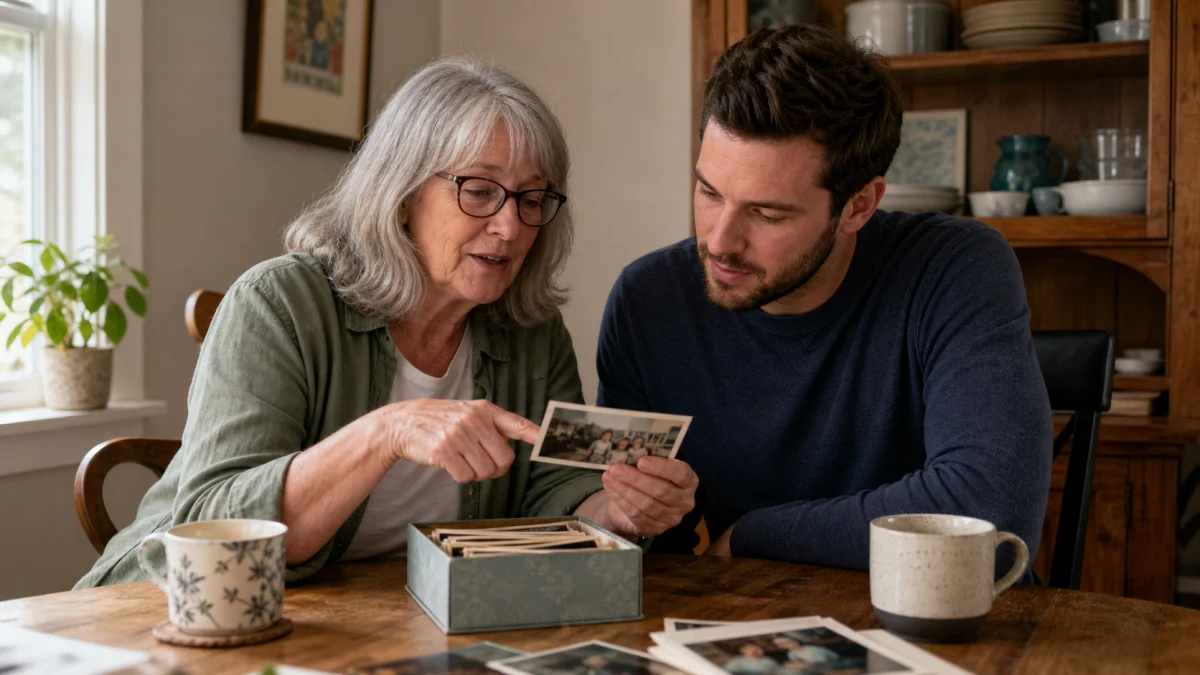
A family photo can do something “How are you?” often cannot: give both people one small, specific place to begin.
You send a picture from lunch, a birthday, or a long-ago vacation. Your parent sends back a heart. The exchange is warm, but the story behind the photo stays untouched. Turning that picture into a conversation does not require a formal interview or a perfect question. It usually requires one invitation, real attention, and room for the answer to be short.
If long conversations already feel difficult to schedule, these low-pressure ways to stay close to family offer other small places to begin.
The short answer
Choose one photo your parent seems comfortable discussing. Notice something before you ask a question, then use one prompt with no single correct answer. Follow the detail that interests them, share something of your own, and stop before the exchange starts to feel like a test. If they want the story kept, ask permission before recording it or sharing it with anyone else.
Key takeaways
- One photo can provide a shared starting point, but it cannot guarantee a memory or a meaningful response.
- Ask for impressions, stories, and feelings instead of testing names, places, or dates.
- A good follow-up is usually more useful than moving to the next question.
- Let the other person choose another photo, change the subject, or stop.
- The five-step method below is editorial guidance, not a clinically validated intervention.
Why can one family photo make conversation easier?
A photo gives both people something concrete to notice together. Instead of asking someone to summarize a life or retrieve a memory on demand, you can begin with the shirt, the kitchen, the expression, or the dog half-hidden in the corner.
A small 2021 Japanese study by Lei Jiang and colleagues offers a useful clue about what matters. Its first stage involved 16 younger and 12 older adults, followed by conversations involving 11 older and 7 younger participants. The pairs discussed public historical photos for one minute at a time. Older participants reported more pleasure when they wanted to talk about the photo, and their pleasure was positively related to the younger participant’s interest in the topic (A Library of Old Photos Supporting Conversation of Two Generations).
The study was tiny, took place in Japan, and used public historical images rather than personal family photos. It does not prove that a photo will make two relatives feel closer. It supports a narrower and more practical point: the storyteller’s willingness and the listener’s genuine interest matter more than finding an objectively “perfect” picture.
Conversation context matters too. A preregistered study published in August 2026 compared structured autobiographical interviews with naturally occurring conversations captured by a smartphone app. Among 24 younger and 50 cognitively normal older adults, the older group shared more episodic detail in natural conversation than in the formal interview context. Young and older adults did not significantly differ in the specificity of the event memories they shared in everyday conversation (McVeigh and colleagues, 2026).
That study was not about photos, parent-child conversations, or a particular prompting method. Its value here is modest but important: do not mistake interview performance for everything an older adult can or wants to say in a familiar social exchange.
The goal is not to extract the correct story from a photo. It is to give a story, reaction, or shared moment somewhere to begin.
A five-step way to turn one photo into a conversation
Choose one welcomed photo. Use one clear image, current or old. Ask, “Feel like looking at this one with me?” If the answer is uncertain, offer another photo or leave it for another day.
Notice before you ask. Offer a detail of your own: “I love the wallpaper in this kitchen” or “Everyone looks windswept.” You are joining the conversation, not administering it.
Invite, do not quiz. Ask one question with no single right answer. “What catches your eye?” is gentler than “Who is that?” or “Do you remember where this was?”
Follow one detail and share too. Echo the detail that carried energy, ask one follow-up, and add your own reaction instead of reaching for the next prompt.
Close or keep it with permission. Let a two-minute conversation remain two minutes. If they want the story saved, agree on one caption or voice note and ask before recording or sharing it.
This approach also fits a broader rhythm of helping parents feel part of everyday family life. The photo does not need to be historic or impressive. A crooked pancake from this morning can be as useful as a wedding picture from 40 years ago.
Twelve family photo conversation starters that do not feel like a test
The best prompt is the one that leaves room for the other person to decide what matters. Choose one, not all 12. If the answer opens a path, follow it.
| Prompt | What it invites |
|---|---|
| “I found this one and wondered what it brings up for you.” | An open response with no expected fact |
| “What catches your eye first?” | A detail chosen by them |
| “What feels familiar here?” | A person, place, object, or feeling |
| “Anything you feel like telling me about this moment?” | Permission to lead or decline |
| “What was this place like to be in?” | The setting beyond the image |
| “What was it like being with the people in this picture?” | Relationships rather than names |
| “What might have been happening just before or after this?” | A wider scene or story |
| “What sounds, smells, or little details go with this scene?” | Sensory detail |
| “What made this day ordinary, funny, difficult, or special?” | Their interpretation of the moment |
| “Does this connect to another story you like telling?” | A memory beyond the frame |
| “What has changed since then, and what still feels the same?” | A then-and-now reflection |
| “What would you want someone younger in the family to know about this moment?” | Meaning in their own words |
These are conversation options, not a questionnaire. “I don’t know,” a laugh, or a change of subject is still a complete response.
If a photo is not available, the existing guide to more questions to ask your parents offers broader prompts about everyday life, younger years, current interests, and future plans.
How do you listen without turning the moment into an interview?
Stay with what the person gives you instead of measuring how much they remember. That means allowing pauses, acknowledging a detail, and treating your parent as the expert on what the picture means to them.
A 2022 Australian pilot taught elaborative reminiscing techniques to 16 aged-care staff. Thirteen staff submitted 26 recorded conversations over four weeks. Open-ended prompting and “centering” behaviors, such as acknowledging expertise and following the older person’s lead, were associated with more autobiographical detail in those conversations (Harris and colleagues, 2022).
The pilot had no baseline conversation sample, most participants were women, recordings varied, and many residents had some cognitive impairment. It cannot show that these techniques caused better memory. It does offer practical behaviors worth borrowing carefully.
- Echo before redirecting: “That porch was where everyone gathered.”
- Ask one follow-up: “What did you like about being out there?”
- Share something back: “I think that is why I love sitting outside too.”
- Leave silence alone for a moment: Thinking time is not a failed conversation.
- Do not correct every difference: Preserve uncertainty when a name or date is unclear.
A 2001 Psychological Bulletin review by Monisha Pasupathi described conversational remembering as co-constructed by the speaker, listener, and context. It was a conceptual review, not a photo study or intervention trial, so it does not tell families which version of a memory is factually right. It does explain why the listener is part of the exchange, not a neutral collector checking answers (The Social Construction of the Personal Past).
What if the memory is unclear, short, or painful?
Connection matters more than completion. If your parent says, “I don’t remember,” respond to the photo rather than increasing the pressure. You might say, “No problem. I just liked seeing you in that coat,” share what you know, or choose another picture.
If a parent has Alzheimer’s disease or another diagnosed memory disorder, follow their care guidance. The National Institute on Aging advises allowing time, listening, avoiding arguments, and not asking whether the person remembers someone or something (NIA communication guidance, updated July 22, 2026). That is clinical guidance for Alzheimer’s, not a rule to impose on every healthy older adult.
Photos can also carry grief, estrangement, embarrassment, or family conflict. Watch the person’s words and energy. If they become uncomfortable, name the choice plainly: “We can put this one away.” Do not insist that a difficult memory must become healing or meaningful.
How should you keep the story behind the photo?
Save one useful detail, with permission, instead of trying to produce a perfect family archive. Add a short caption, note the speaker’s wording, or record a voice message if they agree. If a date is uncertain, keep the uncertainty: “Mom thinks this was around 1978” is more honest than silently converting a guess into a fact.
Also ask who may receive the story. Consent to tell you something is not automatically consent to post it in a group chat, social feed, or public family-history site. The person can say yes to the conversation and no to the recording.
This idea also shapes why HeyBondi starts with ordinary photos: the picture matters most when it carries enough context to become a shared moment. The product is still in development, and no device can guarantee closeness or replace calls, visits, and attentive listening.
Frequently asked questions
Should I use an old photo or a recent one?
Use whichever photo feels welcome and gives both of you something to notice. An old photo may lead to a past story; a recent photo may invite advice, humor, or a present-day connection. Personal interest matters more than the age of the picture.
What if my parent does not remember the photo?
Accept the answer without testing them again. Comment on something visible, share what you know, ask how the image feels to them now, or move to another photo. If memory changes are affecting everyday tasks or causing concern, a photo conversation is not an assessment; discuss the changes with a qualified health professional.
How many photos should we look at?
Start with one. Continue only while both people are interested. The purpose is a natural exchange, not completing an album or reaching a target number.
Should I record the conversation?
Only after asking clearly. Explain how the recording will be stored and who may hear it. If the person declines, keep the moment private or ask whether a short written caption would feel comfortable.
Can this work by text or video call?
Yes. Send one image with a single prompt, or hold it up during a call. Do not make an immediate reply a requirement. A voice note, email, printed picture, or familiar messaging app may suit one family better than a live video conversation.
Begin with one photo, not a perfect question
A meaningful family conversation can be small. Choose one picture, offer one observation, and ask one question that has no right answer. Then listen for the detail your parent chooses.
If the conversation lasts two minutes, let two minutes count. The success is not a complete record of the past. It is one moment in which a picture became something you experienced together.