
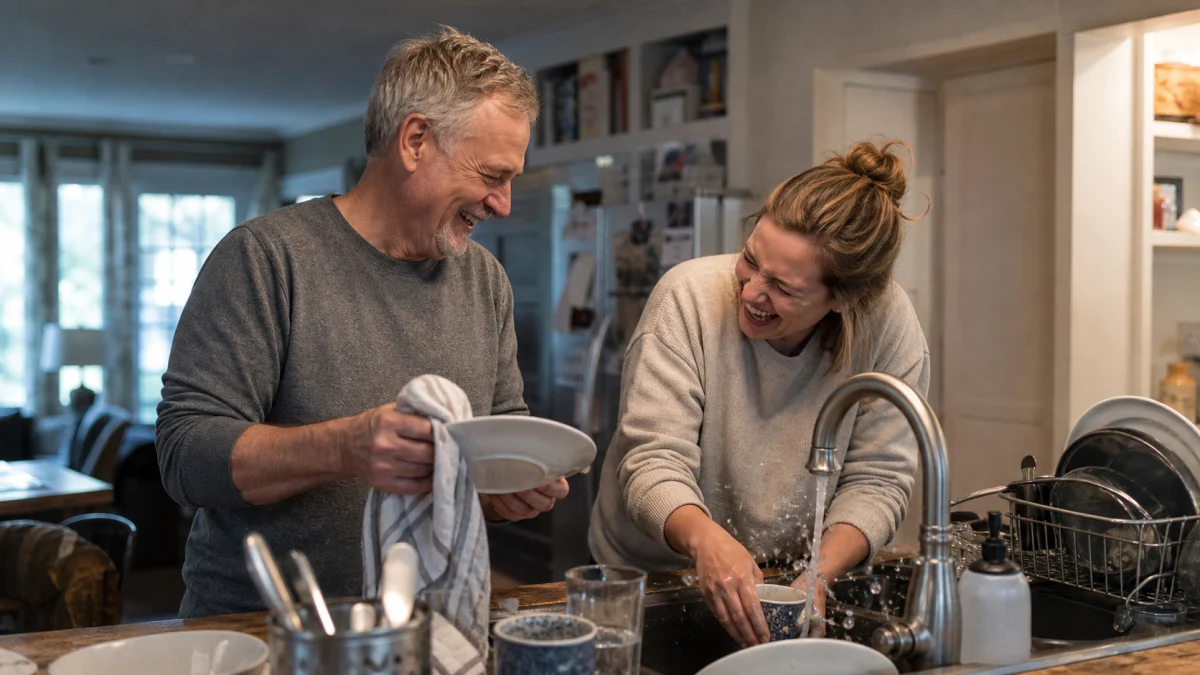
The photo that stops you years later may not be the wedding portrait. It may be your mother leaning against the kitchen counter, your father holding a grocery bag, or a child asleep beside a pile of laundry nobody had time to fold.
Ordinary family photos become valuable because the ordinary part does not stay available. Rooms change. Voices change. People move. The mug, haircut, wallpaper, and half-finished dinner that once seemed too familiar to notice become evidence of how life actually felt. That is also the idea behind preserving everyday family moments: milestones tell us what happened, while ordinary images help us remember how we lived between them.
The short answer
Ordinary family photos often gain value because people underestimate how interesting everyday records will become after details fade. A photograph can cue stories, relationships, and a sense of continuity between past and present. Its meaning comes from context and lived history, not technical perfection. Research supports those mechanisms, but it does not show that every old photo will feel warm or that photographs preserve a complete, objective memory.
Key takeaways
- People tend to underestimate their future interest in records of ordinary experiences.
- A family photo’s later value often comes from the story and relationship attached to it, not the visible subject alone.
- Nostalgia research links remembered experiences with social connectedness, meaning, and continuity of identity, but most studies are not specifically about photographs.
- Photos preserve selected visual details, not a complete or neutral copy of the past.
- A date, name, place, or sentence of context can become part of what makes an image understandable later.
Ordinary life feels too familiar to become history
We overlook ordinary photos because the information inside them still feels available. You know whose kitchen it is. You know why the chair is by the window. You can picture your father’s old jacket without assistance. A photograph of those things can seem unnecessary because the present creates an illusion of permanent access.
Research suggests that we are not very good at predicting what future us will want to recover. In the 2014 paper “A ‘Present’ for the Future: The Unexpected Value of Rediscovery”, Ting Zhang and colleagues conducted four longitudinal studies with delays ranging from one to seven months. Samples included university students, adults in relationships, and online participants, with completed samples generally ranging from about 48 to 106 per study.
Participants underestimated how curious and interested they would later feel about records of ordinary experiences. In one study, only 27% initially chose to document a recent conversation rather than watch a video, but one month later 58% preferred reading the record. The study concerned written records and time capsules as well as ordinary events, not family photographs, and its follow-up periods were short. It supports the mechanism of underestimated rediscovery, not a claim that every candid photo becomes precious.
The everyday photo gains value when the everyday knowledge around it is no longer effortless.
A family photo becomes a cue, not just a record
A meaningful photo points beyond its visible content. A picture of a table can restore who sat where, which chair wobbled, and who always began clearing plates before everyone finished. The visible object is a handle for a much larger memory.
Daniela Petrelli, Simon Bowen, and Steve Whittaker explored this idea in “Photo Mementos: Designing Digital Media to Represent Ourselves at Home”, published in 2014. Their researchers conducted “memory tours” through 17 British households and asked participants to select and narrate meaningful objects in public, family, and private spaces.
Selected photos often carried symbolic meanings known primarily to their owners. A picture in a shared room could reinforce family bonds or invite conversation, while a private image could support more personal reminiscence. This was a small qualitative study of chosen mementos, not a representative survey of all photos. Six participants selected no photographs at all. Its useful finding is that meaning depends on the person, story, and setting, not that photographs matter equally to everyone.
Small details hold the texture of family life
The most ordinary details can become the most specific evidence of a person. Formal portraits preserve faces and occasions. Candid photographs also preserve posture, clutter, half-used objects, and the way someone occupied a room when nobody was arranging the scene for history.
A 2023 study in The Gerontologist asked 15 adults aged 66 to 89 to take one photograph and write a short narrative about purpose and meaning each day for 15 days. Participants repeatedly documented ordinary subjects such as coffee, nature, hobbies, and relationships. The sample was tiny, recruited partly through an art center, and studied during the pandemic, so it cannot show what all older adults value. It does demonstrate how quickly supposedly minor subjects can become containers for meaning when people are invited to notice them.
That is why a kitchen snapshot may eventually say more than “someone was cooking.” It can show the apron your mother wore, the radio your father kept beside the sink, or the plastic container your family refused to throw away. These details resemble the family habits that become meaningful with distance: their value lies in being attached to a particular person and repeated life.
| A photo may preserve | Context must supply | A photo cannot guarantee |
|---|---|---|
| Faces, rooms, clothing, objects | Names, relationships, place, date | A complete account of the event |
| A gesture or expression | What happened before and after | The person’s exact emotion |
| Evidence of a routine | Why the routine mattered | That everyone experienced it alike |
| A visual memory cue | The story the family tells | An objective version of the past |
The photograph and the family story do different jobs. Keeping both can make the record more useful without making it perfectly complete.
Nostalgia can connect past and present
Old photos can feel powerful because they help organize a story about continuity. They place a past self, a relationship, and a present viewer in the same mental frame.
A 2024 cross-cultural study led by Erica Hepper included 2,606 young adults across 28 countries plus Hong Kong. The research on nostalgia across cultures measured common triggers and experimentally compared nostalgic with ordinary recall. Nostalgic recall increased reported social connectedness, self-continuity, and meaning across the combined sample, though results and baselines differed among countries.
A related paper by Emily Hong, Constantine Sedikides, and Tim Wildschut examined nostalgia and global self-continuity across five studies with 1,074 participants. The studies, published online in 2021 and in print in 2022, suggested that nostalgia strengthened continuity chiefly through narrative: people connected the remembered event into a story about themselves.
Both research programs relied substantially on self-report, and their experimental samples were mostly young or middle-aged adults recalling events rather than viewing family photographs. Applying their findings to old photos is an evidence-informed interpretation. The research supports what nostalgia can do after it is evoked; it does not show that any specific photograph will produce it.
A photo preserves attention, not the whole moment
Photographs are selective witnesses. They show what entered the frame and what the photographer attended to. They do not automatically preserve the sound of the room, the disagreement before dinner, or the person standing behind the camera.
Alixandra Barasch and colleagues tested that selectivity in “Photographic Memory”, published in 2017. Across a museum field study, three main laboratory studies, supplemental experiments, and meta-analyses, the main final samples totaled 1,692 participants. People who chose to take photographs later recognized more visual information but less auditory information than people without cameras.
The tasks involved museums and simulated galleries, mostly with younger or online participants, and tested memory after short delays without having people review their photos. This was not a study of family albums. Its value here is corrective: a photo can strengthen attention to certain details while narrowing others. The image is not the past itself.
- Supported by research: People can underestimate future interest in ordinary records, and photos can act as autobiographical or relational cues.
- Reasonable synthesis: Everyday family photos may gain value as surrounding details become harder to recall.
- Not established: Ordinary photos are always more valuable than milestone photos, or taking more photos automatically improves memory.
- Emotional caveat: An old family image may evoke warmth, grief, anger, ambiguity, or nothing in particular.
Context eventually becomes part of the photograph
A future viewer may need one sentence that feels unnecessary today. “Mom in her first apartment, Cleveland, 1998” can matter more than a perfect filter. So can the answer to “What was happening here?”
This does not need to become a large preservation project. A person’s name, approximate date, place, and one unusual detail often provide enough footing for a future story. If the person is available and willing, one of these specific questions to ask a parent may recover context without demanding a complete life history.
Context can also remain spoken. A photograph shown during a call may prompt a correction, laugh, or completely different version of events. That conversation does not make the image objectively true. It makes the family record richer. For a gentle starting point, try turning one family photo into a conversation.
Not every family photo becomes a treasure
Family photographs are not emotionally neutral, and warmth is not an obligation. A picture can preserve grief, conflict, exclusion, or a relationship that is no longer safe. You can value the historical record without displaying it. You can keep an image private, add your own context, or decide not to revisit it.
A 2022 systematic review by María Toledano-González and colleagues screened 1,098 records and included only six intervention studies involving autobiographical photographs and older adults. The review found promising effects involving well-being, identity, cognition, or quality of life, but the studies were few and heterogeneous and included both healthy and cognitively impaired participants. These structured interventions are not equivalent to casually scrolling a family archive. They do not justify claims that photo viewing treats loneliness or prevents cognitive decline.
The honest conclusion is smaller and more useful: photographs can help some people access stories and relationships. Whether that feels comforting depends on the person, image, and moment.
What makes the ordinary photo valuable
The ordinary family photo becomes precious not because it was secretly extraordinary all along, but because it preserved information that once seemed impossible to lose. It kept the familiar room, ordinary posture, unremarkable afternoon, and person who did not know they were becoming a memory.
You do not need to photograph every minute or turn family life into an archive assignment. Notice what is representative. Keep enough context for someone to enter the scene later. Share without creating a response obligation, using the same low-pressure spirit as these small ways to stay close to family.
Years from now, the picture that matters may still be the imperfect one. That is not a failure of photography. It is evidence that a life was happening before anyone knew which parts they would miss.
Frequently asked questions
Why are family photos important?
Family photos can preserve visual details, cue autobiographical stories, and help people connect past relationships with their present identity. Their meaning depends on context and personal history, so the same image may matter differently to different relatives.
Why do ordinary photos become more meaningful over time?
Everyday details feel permanently available while we are living among them. As people, rooms, and routines change, a plain photograph can restore information that is no longer easy to recover. Research also suggests that people underestimate their future interest in ordinary records.
Are candid family photos better than posed photos?
Neither is universally better. Posed photographs can clearly preserve faces and milestones, while candid images often retain routines, surroundings, and spontaneous interactions. A varied collection usually preserves more kinds of family information.
Do photos improve memory?
They can cue memories and strengthen attention to visual details, but they do not preserve a complete memory. Experimental research has found that taking photos can improve later visual recognition while reducing attention to auditory information.
How can families preserve the stories behind old photos?
Add names, approximate dates, places, and one sentence about what was happening. When it feels welcome, ask the people pictured for their version. Adult children can also use ordinary photo-sharing as one way to help parents feel included in everyday family life.