

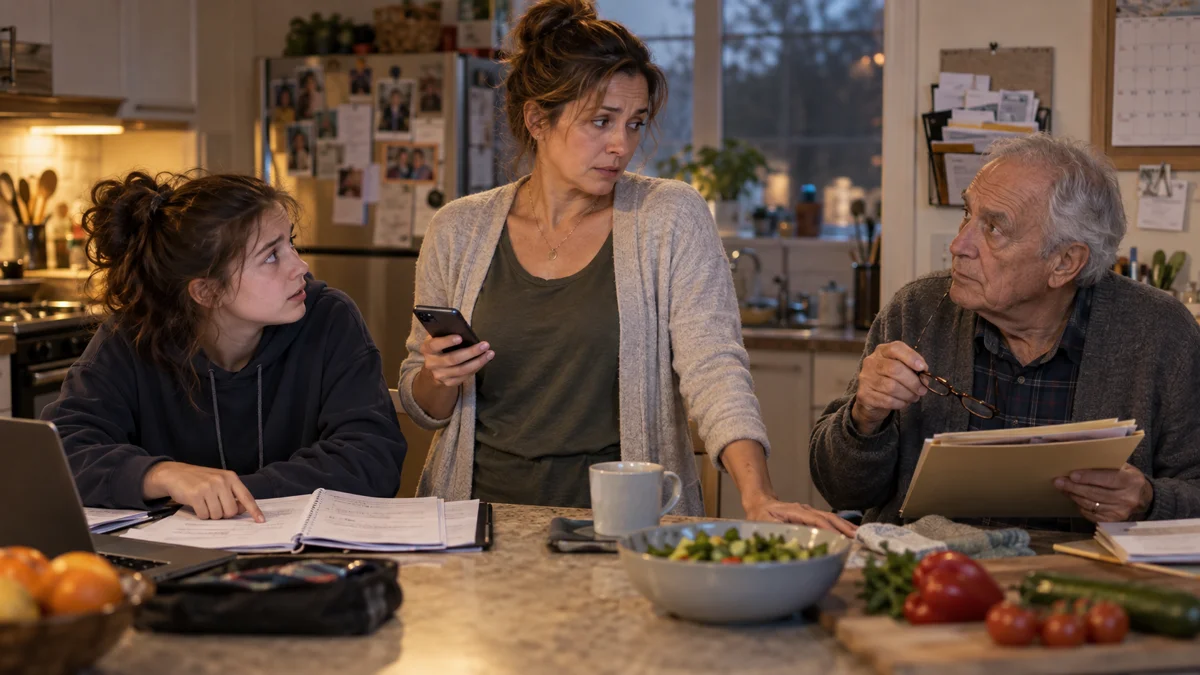
The sandwich generation is made up of adults who support aging parents while also raising children or financially supporting adult children. The pressure comes from being responsible in two directions at once, often while trying to hold a job, a relationship, and your own health together.
It can look like a school pickup interrupted by a pharmacy call. It can sound like “I am fine” from a parent and “I need money by Friday” from a child. Nobody is necessarily asking for too much on purpose. The impossible part is that every need feels legitimate, and many of them arrive at the same time.
Sandwich generation definition
The sandwich generation refers to adults positioned between the needs of an older generation and a younger generation. The exact research definition varies. Pew Research Center counts adults with a living parent age 65 or older who also have a minor child or financially supported an adult child in the prior year. Caregiving studies often use a narrower definition that requires active care for an adult alongside raising a child.
How common is the sandwich generation?
It is common enough to be a structural family pattern, not a private failure. A Pew Research Center analysis published in August 2026 found that 25% of U.S. adults met its sandwich-generation definition. Among adults in their 40s, the share was 54%. The findings came from a survey conducted September 2 to 8, 2025.
A separate AARP and National Alliance for Caregiving report, published September 15, 2026, estimated that nearly 17 million people were both raising children and caring for an adult with a complex medical condition or disability. That represented 29% of adult caregivers in the study.
Those figures measure different groups, so they should not be merged into one number. Pew captures the demographic squeeze, including financial support. AARP and NAC focus on people doing active caregiving. Both show the same underlying reality: a large part of midlife is now spent supporting family on both sides.
Why does it feel so hard even when no single task looks impossible?
The strain comes from coordination, interruption, and emotional switching, not only from hours. You can spend one minute explaining homework, the next reading a medical message, then walk into a work meeting pretending your attention is intact.
The 2026 AARP and NAC report found that sandwich-generation caregivers averaged about 27 hours of care per week, roughly the same as other adult caregivers. The difference was intensity. They handled more daily tasks and were more likely to perform medical or nursing work at home. Nearly half, 48%, were in high-intensity caregiving situations.
This is why “just make a list” can feel insulting. The burden is not a single list. It is being the person who notices what belongs on every list, remembers every deadline, and absorbs the panic when one system fails.
Everyone can see one thing you forgot. Almost nobody can see the hundred things you remembered.
Who counts as part of the sandwich generation?
The classic image is a parent in their 40s caring for young children and an aging parent. Real families are more varied:
- Traditional sandwich: raising children while helping an older parent with health, transportation, money, or daily tasks.
- Extended sandwich: supporting adult children or grandchildren while also caring for parents or older relatives.
- Club sandwich: three active layers of responsibility, such as children, parents, and grandparents, or grandchildren, adult children, and parents.
- Distance sandwich: coordinating appointments, emergencies, and home support for a parent who lives far away while running your own household.
- Financial sandwich: paying toward a child's education or housing while also covering a parent's care, repairs, or medical costs.
You do not need to live with both generations to feel sandwiched. You also do not need to identify as a caregiver. Many people think they are “just helping” until they list the calls, forms, rides, meals, reminders, and decisions they handle each week.
Signs the pressure has become too much
Overload often appears first as a shrinking margin for ordinary life. One delayed prescription, sick child, or work deadline sends the whole week into crisis because there is no unused capacity left.
- You are the only person who knows the complete schedule.
- You feel resentful, then guilty for feeling resentful.
- Your own appointments, friendships, sleep, or meals are the first things cancelled.
- You cannot enjoy time with either generation because you are thinking about the other one.
- You are making medical, financial, or care decisions without enough information or authority.
- You keep telling people “it is fine” because explaining the whole situation feels like another task.
These signs are not a diagnosis. They are reasons to make the load visible. The CDC's caregiver guidance recommends consistent breaks, help with errands and care planning, attention to the caregiver's own health, and mental health support when needed.
What actually helps the sandwich generation?
1. Divide ownership, not isolated errands
“Tell me what to do” leaves one person as the family dispatcher. Give complete areas to specific people: one sibling owns prescriptions, another owns transport, one partner owns school communication, and one adult child handles the weekly grocery order. Ownership includes noticing, scheduling, following up, and reporting back.
2. Create one family source of truth
Use a shared calendar or document for medications, appointments, emergency contacts, school dates, insurance details, and open decisions. Protect sensitive information and share only what each person needs. The goal is not surveillance. It is making sure family knowledge does not live in one exhausted person's head.
3. Separate connection from administration
If every call with a parent is about blood pressure, bills, or appointments, the relationship can begin to feel like a case file. Protect some contact that has no task attached: a photograph from lunch, a voice note about the weather, or a question about an old recipe. These low-pressure ways to feel closer are small enough to survive a crowded week.
4. Ask the parent what autonomy means to them
Help can become control when fear takes over. Ask which decisions your parent wants to keep, what information they want shared, and where they would welcome backup. A clear conversation now can prevent a fight during a crisis. Start with curiosity instead of an assessment; these questions for better parent conversations can help.
5. Put respite on the calendar before collapse
A break that depends on everything becoming calm may never happen. Arrange coverage for a repeatable block, even if it is only a few hours. If the situation includes disability or complex care, local agencies, adult day programs, nonprofits, or health systems may have respite options. Availability and eligibility vary by location.
6. Name the financial layer directly
The AARP and NAC report found work disruption was common among sandwich-generation caregivers, and 22% reported high financial strain. Families need explicit conversations about what each person can contribute, what no one can afford, which documents are missing, and when professional financial or legal advice is necessary. Silence does not make the cost disappear. It makes the person paying feel alone.
How can family members support someone in the sandwich generation?
Offer a complete action with a time attached. “I can take Dad to his appointment Thursday, wait with him, collect the instructions, and update the shared note” is useful. “Let me know if you need anything” asks the overloaded person to discover, define, assign, and supervise your help.
Useful support can also be ordinary: take the children for a predictable afternoon, send a prepared meal without requiring a visit, make the pharmacy calls, or sit with the older parent so the caregiver can attend their own appointment. Do not wait for the person in the middle to prove they are exhausted enough.
Can technology reduce the pressure?
Technology helps when it removes coordination. It hurts when it creates another dashboard. A shared calendar, medication reminder, video doorbell, or family photo display can support a specific need. Every device should have a named owner, a privacy plan, and a low-friction fallback when Wi-Fi or passwords fail.
For long-distance families, ordinary contact matters too. A photo with one sentence of context can help a parent feel included without demanding a live call at the exact wrong moment. Our guide to sharing family photos without overwhelming your parents offers a calmer rhythm.
Sandwich generation frequently asked questions
What age is the sandwich generation?
There is no fixed age. Adults in their 40s are the most likely to meet Pew Research Center's current definition, but people can be sandwiched in their 30s, 50s, 60s, or beyond depending on family age, disability, finances, and longevity.
Why is it called the sandwich generation?
The term describes adults “sandwiched” between the needs of an older generation and a younger one. It refers to the position in a family system, not a formal medical or legal category.
Is the sandwich generation only about caregiving?
No. Some definitions require active caregiving, while others include financial support for adult children and the presence of an older parent. Always check how a study defines the group before comparing statistics.
What is the biggest challenge for the sandwich generation?
The biggest challenge is often simultaneous responsibility: time, money, attention, and emotional energy are demanded by two generations at once. The hidden coordination work can be as draining as the visible care tasks.
How can I avoid sandwich generation burnout?
Make all work visible, divide complete areas of ownership, protect regular respite, keep your own health appointments, and ask for professional support when stress or care needs exceed what the family can safely handle.
You are not failing. The structure is overloaded.
The sandwich generation is often described as a stage of life, as if everyone simply needs to become more organized until it passes. That misses the tension. Children need steadiness while parents need dignity. Work still expects reliability. Your own body keeps a record of every postponed need.
The first useful step is not doing more. It is naming the whole load so other people can finally see it. Once the work is visible, it can be divided. Once the fear is spoken, decisions can be made before an emergency. And once connection is separated from administration, your parent can become your parent again, not only the next item on the list.